A complete paramedic education, one module at a time.
Over 1,100 hours, the program moves from foundational science through advanced medical and trauma care, special populations, EMS operations, and a comprehensive National Registry review.
The content areas.
Each area is delivered across multiple classes with labs, scenarios, and scheduled review, then reinforced by hospital clinicals and field internship.
01Foundations & Anatomy
02Pharmacology
03Airway & Respiration
04Patient Assessment
05Trauma
06Medical Emergencies
07Special Populations
08EMS Operations
09NREMT Review & Capstone
Terms, reviews, and a capstone.
The sequence is divided into academic terms, each ending in a term final, with midterms and scheduled tutoring throughout. The final block is a comprehensive review across every domain that culminates in the course final and National Registry preparation.
Hospital clinicals
Rotations at leading Cincinnati teaching hospitals.
Field internship
Supervised 9-1-1 rotations with CFD and partner departments.
Scheduled tutoring
Built-in sessions to keep every student on track.
NREMT prep
120 dedicated hours of National Registry preparation.
Train in the region's leading hospitals.
Hospital rotations place you inside top Cincinnati teaching hospitals. At the University of Cincinnati Medical Center you work alongside paid nurse preceptors, with access to a cadaver lab and physician-led rounds.


Know exactly what to expect.
Preview a sample of the Paramedic Program Student Handbook — the mission, program overview, and full table of contents. Admitted students receive the complete handbook.
View the sample handbook (PDF) →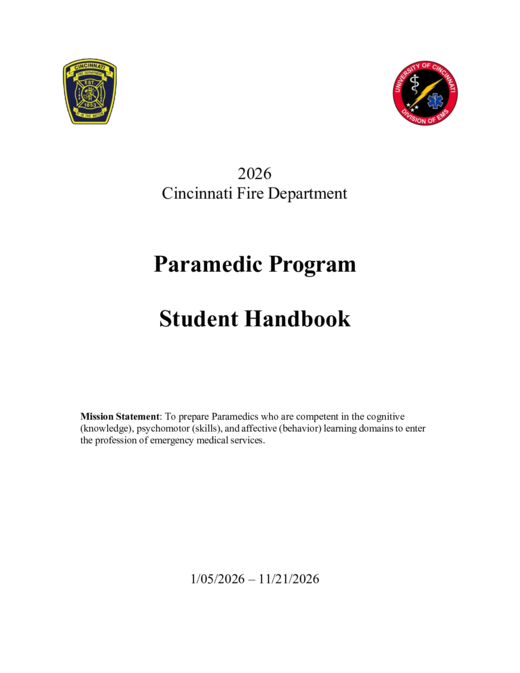
See where the curriculum leads.
Learn how the program prepares you for the National Registry cognitive and psychomotor exams.